ASEAN–India Women Scientists Conclave 2026: Key Outcomes, Strategic Significance & UPSC Notes
ASEAN–India Women Scientists Conclave 2026: Key Outcomes, Strategic Significance & UPSC Notes

Introduction
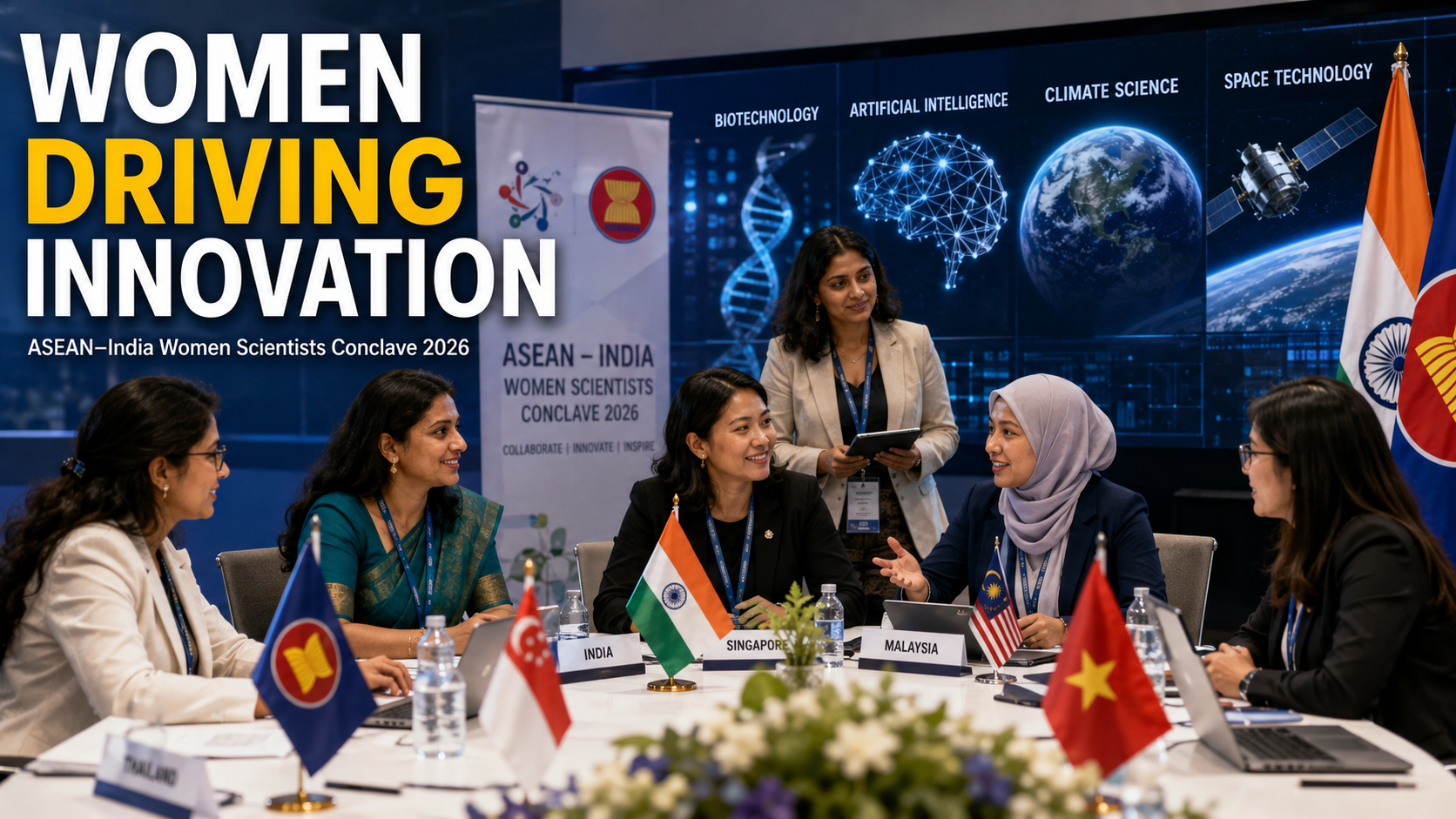
The ASEAN–India Women Scientists Conclave 2026 highlighted the growing role of scientific collaboration in strengthening India–ASEAN relations while promoting greater participation of women in research and innovation. The conclave brought together leading scientists, policymakers, and researchers to discuss emerging technologies and regional challenges.
Beyond scientific exchange, the event reflects India's broader strategy of using science diplomacy to deepen partnerships across Southeast Asia. It also reinforces the importance of women-led innovation in addressing global issues such as climate change, healthcare, food security, and digital transformation.
Why This Matters Now
- Strengthens India–ASEAN cooperation in science, technology, and innovation.
- Encourages greater participation of women in STEM research and leadership.
- Supports collaborative solutions to regional challenges including climate resilience and public health.
Background
India and ASEAN have steadily expanded cooperation beyond trade and security into areas such as education, digital technology, research, and innovation. Science and technology have emerged as important pillars of this partnership.
Women's participation in STEM remains a policy priority across many countries. Collaborative platforms like this conclave promote knowledge exchange, networking, and joint research opportunities while encouraging inclusive scientific development.
Main Analysis
Strengthening India–ASEAN Science Diplomacy
The conclave reinforced scientific engagement as an important component of India's Act East Policy. Research partnerships create long-term institutional links that complement diplomatic and economic cooperation between India and ASEAN member states.
Promoting Women in STEM Leadership
A major focus of the conclave was expanding opportunities for women scientists through mentorship, collaborative research, and leadership development. Greater gender diversity enhances innovation and improves scientific decision-making.
Focus on Emerging Technologies
Discussions covered frontier areas including artificial intelligence, biotechnology, climate science, renewable energy, digital technologies, and public health research. These sectors are increasingly central to regional economic growth and sustainable development.
Building Collaborative Research Networks
The conclave encouraged universities, research institutions, and innovation ecosystems to establish joint projects, researcher exchanges, and capacity-building initiatives. Such collaborations strengthen scientific capabilities across the Indo-Pacific region.
Supporting Sustainable Development Goals
Scientific cooperation contributes directly to achieving several Sustainable Development Goals by improving healthcare, environmental sustainability, disaster resilience, clean energy, and food security through shared innovation.
What This Means for India
For India, the conclave strengthens its image as a trusted scientific partner in Southeast Asia. It supports India's objectives under the Act East Policy, enhances regional innovation partnerships, promotes women-led research, and contributes to stronger people-to-people ties with ASEAN countries.
Such initiatives also expand opportunities for Indian researchers, startups, academic institutions, and technology-driven industries to collaborate with neighboring economies.
What Happens Next
Best Case
Joint research projects expand significantly, leading to breakthrough innovations and stronger institutional cooperation across India and ASEAN.
Most Likely Case
Scientific exchanges, training programs, and collaborative research continue to grow steadily under existing India–ASEAN cooperation frameworks.
Worst Case
Limited funding or geopolitical uncertainties slow the pace of collaborative scientific initiatives despite continued diplomatic engagement.
Conclusion
The ASEAN–India Women Scientists Conclave 2026 demonstrates how science can strengthen international partnerships while promoting inclusive development. By encouraging women-led innovation and expanding research collaboration, the initiative supports both regional cooperation and sustainable growth. For UPSC aspirants, the conclave is an important example of science diplomacy intersecting with foreign policy, gender empowerment, and technological advancement.
UPSC Prelims Facts
- ASEAN consists of 10 member countries.
- India is a Strategic Partner of ASEAN.
- Science diplomacy combines scientific cooperation with foreign policy objectives.
- Women in STEM is an important focus of India's science and innovation ecosystem.
- The conclave promotes research collaboration, innovation, and regional capacity building.
Mains Value Addition
GS Paper II: India–ASEAN Relations, International Cooperation
GS Paper III: Science & Technology, Innovation, Research & Development
Essay Themes:
- Women in Science
- Science Diplomacy
- Regional Cooperation
- Innovation for Sustainable Development
FAQs
1. What is the ASEAN–India Women Scientists Conclave?
It is a collaborative platform that brings together women scientists from India and ASEAN countries to promote research partnerships and scientific cooperation.
2. Why is the conclave important?
It strengthens science diplomacy, promotes women in STEM, and deepens India–ASEAN relations.
3. Which sectors were emphasized?
Artificial intelligence, biotechnology, climate science, renewable energy, digital technologies, healthcare, and sustainability.
4. Why is it relevant for UPSC?
The topic links Science & Technology, International Relations, Women Empowerment, and India's Act East Policy.