Bank of Baroda Data Leak: How Secure Is Your Banking Data?
Bank of Baroda Data Leak: How Secure Is Your Banking Data?

Introduction
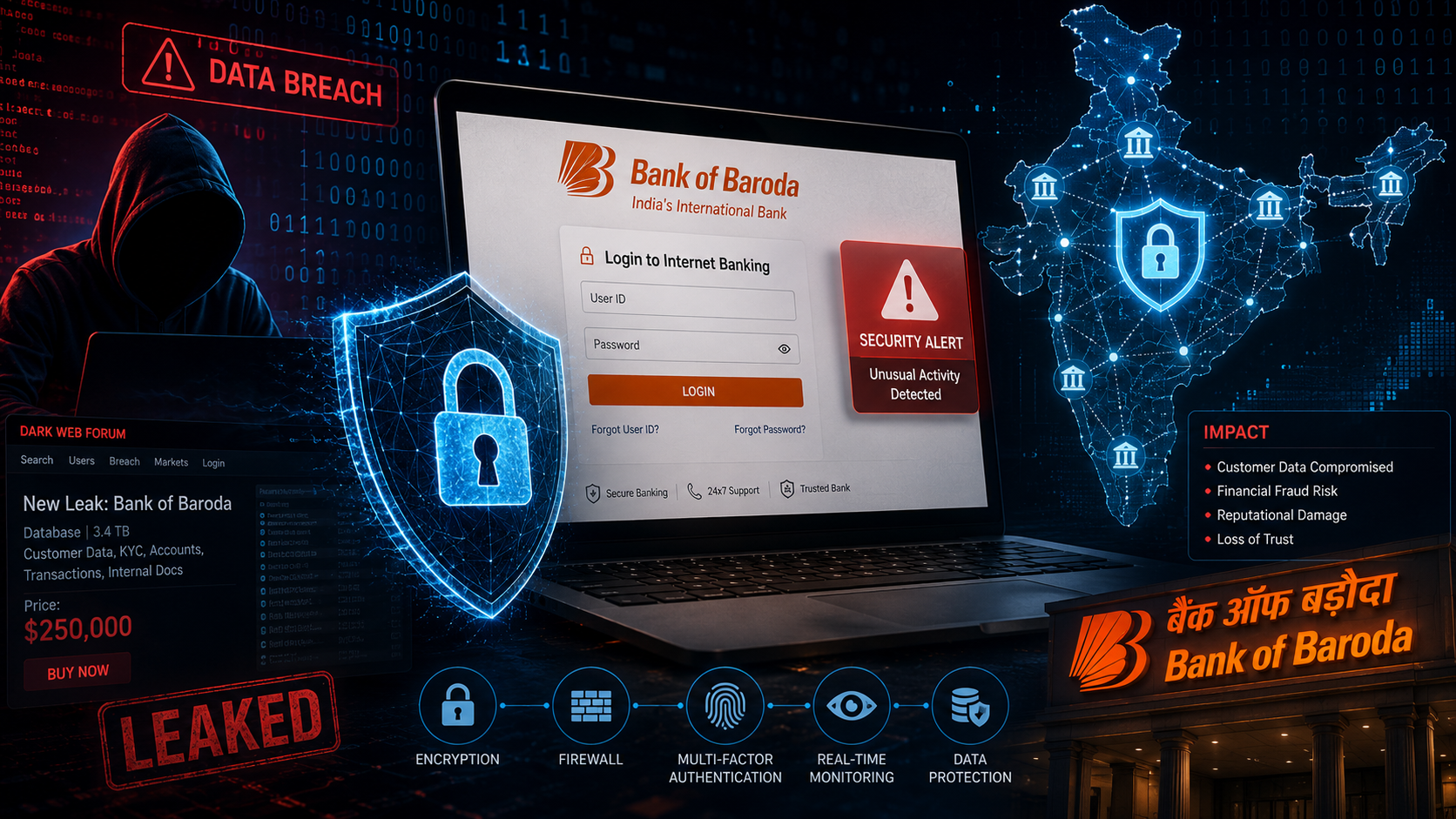
The Bank of Baroda data breach has become one of India's most significant banking cybersecurity incidents in recent years. The bank confirmed that an employee's email account was compromised, leading to unauthorized access to certain data. It stated that its core banking systems were not compromised and that a forensic investigation had been launched.(https://www.ojaank.com/)
The incident has renewed attention on cybersecurity in the financial sector. Even when core banking infrastructure remains secure, leaked customer information can expose individuals to phishing, identity theft, and financial fraud.
Why This Matters Now
- The incident highlights growing cyber threats targeting India's financial institutions.
- Sensitive customer information can be misused for phishing and social engineering attacks.
- The breach reinforces the importance of RBI's cybersecurity framework and rapid incident reporting.
Background
According to the bank, the breach originated from a compromised employee email account, which allowed unauthorized access to certain information. The bank emphasized that its core banking platform remained secure and initiated a forensic audit while coordinating with relevant authorities.
Independent reports indicated that data allegedly appearing on the dark web included customer records, identity documents, loan-related files, and internal documents. However, the full extent of the leaked data and the number of affected customers were still under investigation at the time of reporting.
Main Analysis
What Exactly Happened?
The confirmed breach involved an employee email account rather than the bank's core banking infrastructure. This distinction is important because a data breach does not necessarily mean that customer accounts or transaction systems have been directly compromised.
What Are the Cyber Security Risks?
If customer information is exposed, attackers may use it to launch:
- Phishing emails
- Fake customer-care calls
- Identity theft
- SIM swap attempts
- Credential theft
- Social engineering scams
The greatest immediate danger is often not unauthorized fund transfers but convincing fraud attempts using genuine customer information.
RBI's Cyber Security Framework
The Reserve Bank of India (RBI) requires regulated entities to maintain robust cybersecurity systems, detect cyber incidents promptly, strengthen operational resilience, and report significant cyber incidents to regulators.
Banks are expected to implement:
- Multi-factor authentication
- Continuous security monitoring
- Employee cybersecurity awareness
- Risk-based access controls
- Incident response and recovery plans
- Regular security audits
These measures aim to minimize cyber risks and improve customer protection.
Role of CERT-In
The Indian Computer Emergency Response Team (CERT-In) serves as India's national agency for responding to cybersecurity incidents. It coordinates technical responses, issues advisories, shares threat intelligence, and assists organizations during major cyber events.
Financial institutions often work alongside CERT-In during investigations involving significant cyber incidents.
What Should Customers Do?
Customers should remain vigilant rather than panic.
Recommended precautions include:
- Change internet banking passwords if advised.
- Enable SMS and email transaction alerts.
- Never share OTPs or banking credentials.
- Ignore suspicious calls claiming to be from the bank.
- Regularly monitor account statements.
- Report suspicious activity immediately to the bank and cybercrime authorities.
Experts note that a data leak alone does not automatically allow attackers to withdraw money from customer accounts. The larger threat comes from fraudsters exploiting leaked information through deception.
What This Means for India
The incident demonstrates that cybersecurity has become a critical component of financial stability. As India rapidly expands digital banking, UPI, and fintech services, protecting customer data is increasingly important for maintaining trust in the financial system.
For policymakers, the breach underscores the need for stronger cyber resilience, better employee security practices, continuous monitoring, and enhanced public awareness against online fraud.
What Happens Next
Best Case
The forensic investigation identifies the breach completely, vulnerabilities are closed, and affected customers receive timely protection while cybersecurity practices across the banking sector improve.
Most Likely Case
Investigations continue, regulators review compliance, and banks strengthen email security, access controls, and employee awareness to reduce future risks.
Worst Case
If stolen information is widely misused, customers could face increased phishing campaigns, identity theft attempts, and financial fraud despite secure core banking systems.
Conclusion
The Bank of Baroda data breach illustrates that modern cyber threats often target the weakest point in an organization's security chain rather than its core infrastructure. While the bank has stated that its core banking systems remained secure, the incident highlights the importance of strong cybersecurity governance, employee awareness, timely incident response, and customer vigilance.
For UPSC aspirants, this development connects Science & Technology, Cyber Security, Governance, Digital Economy, and Financial Regulation, making it highly relevant across multiple papers.
UPSC Prelims Facts
- CERT-In is India's national cyber incident response agency.
- RBI regulates cybersecurity standards for banks and financial institutions.
- Bank of Baroda stated that the breach involved a compromised employee email account, while core banking systems remained unaffected.
- The bank has initiated a forensic investigation to determine the full extent of the incident.
- Phishing and social engineering remain among the biggest post-breach risks for customers.
Mains Value Addition
GS Paper II: Digital Governance, Financial Regulation
GS Paper III: Cyber Security, Banking Technology, Internal Security
Essay Themes:
- Cyber Security in Digital India
- Trust and Security in Digital Banking
- Data Protection and Financial Stability
- Building Cyber-Resilient Public Institutions
FAQs
1. What caused the Bank of Baroda data breach?
The bank stated that the breach resulted from a compromised employee email account, not from its core banking systems.
2. Were customer bank accounts directly hacked?
According to the bank, core banking systems remained secure. However, exposed customer information may increase the risk of phishing and fraud.
3. What is the biggest risk after a data breach?
Phishing attacks, identity theft, fake customer-support calls, and social engineering scams.
4. Which authority handles major cyber incidents in India?
CERT-In is the national agency responsible for coordinating responses to cybersecurity incidents.
5. Why is this topic important for UPSC?
It links Cyber Security, Digital Banking, Governance, Financial Regulation, Data Protection, and Current Affairs.