Buddhist Heritage Sites of India: UNESCO Sites, Cultural Significance & UPSC GS-I Analysis
Buddhist Heritage Sites of India: UNESCO Sites, Cultural Significance & UPSC GS-I Analysis

Introduction
India is the birthplace of Buddhism, one of the world's oldest and most influential religions. From the Buddha's enlightenment at Bodh Gaya to his first sermon at Sarnath, the country preserves some of the most sacred Buddhist monuments and archaeological sites in the world.
The inscription of the Ancient Buddhist Site of Sarnath on the UNESCO World Heritage List in 2026 has renewed global attention towards India's Buddhist heritage. The recognition makes Sarnath India's 45th UNESCO World Heritage Site and further strengthens India's position as the spiritual heartland of Buddhism.
Why This Matters Now
- Sarnath became India's 45th UNESCO World Heritage Site during the 48th Session of the World Heritage Committee in Busan, Republic of Korea.
- Buddhist heritage strengthens India's soft power, cultural diplomacy, and tourism.
- The topic is highly relevant for UPSC Prelims, GS-I (Art & Culture), GS-II (International Relations), and Essay.
Background
Buddhism originated in the 6th century BCE with Gautama Buddha. The religion spread from the Gangetic plains to Sri Lanka, Central Asia, Southeast Asia, China, Korea, Japan, and beyond through monks, traders, and royal patronage.
Emperor Ashoka played a decisive role in spreading Buddhism by constructing stupas, pillars, monasteries, and sending missionary delegations across Asia. Today, India's Buddhist monuments represent over two millennia of religious, artistic, and architectural evolution.
Main Analysis
Bodh Gaya: The Place of Enlightenment
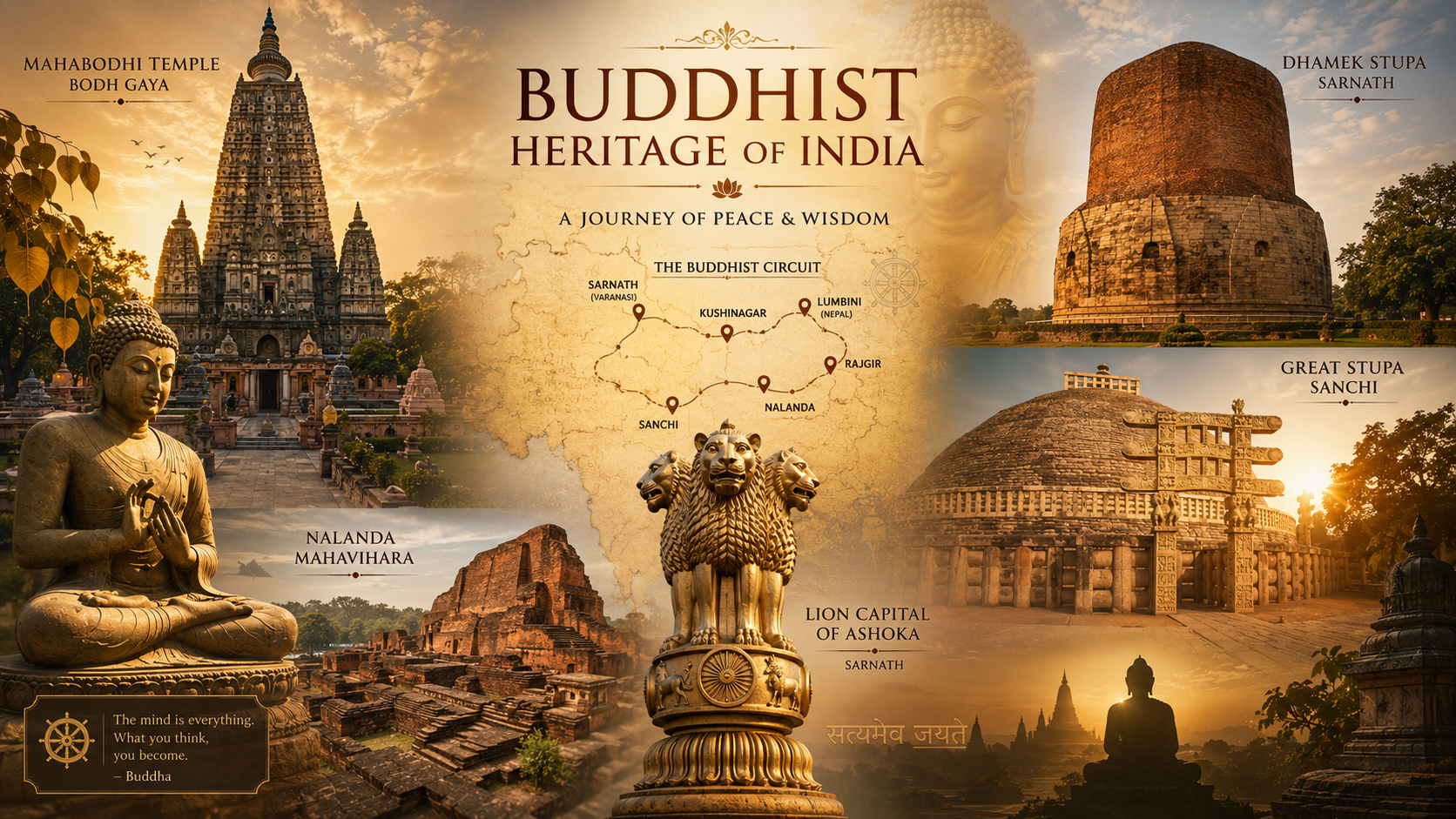
The Mahabodhi Temple Complex at Bodh Gaya (Bihar) marks the place where Siddhartha Gautama attained enlightenment beneath the Bodhi Tree. It has been a UNESCO World Heritage Site since 2002 and remains one of the holiest pilgrimage destinations for Buddhists worldwide.
Sarnath: Where Buddhism Began to Spread
Located near Varanasi, Sarnath is where Buddha delivered his first sermon (Dhammachakra Pravartana) and established the first Buddhist Sangha. The site contains the Dhamek Stupa, Ashokan Pillar, monasteries, and ancient temples. In 2026, UNESCO inscribed Sarnath as India's 45th World Heritage Site, recognizing its Outstanding Universal Value.
Sanchi: India's Finest Stupa Complex
The Buddhist Monuments at Sanchi (Madhya Pradesh) were commissioned primarily by Emperor Ashoka in the 3rd century BCE. The Great Stupa, intricately carved gateways (Toranas), monasteries, and pillars illustrate the evolution of Buddhist architecture and art. Sanchi has been on the UNESCO World Heritage List since 1989.
Nalanda Mahavihara: Ancient Centre of Learning
The Archaeological Site of Nalanda Mahavihara (Bihar) was one of the world's earliest residential universities. It attracted scholars from across Asia and became a major centre for Buddhist philosophy, medicine, mathematics, and logic before its decline in the 12th century. UNESCO inscribed Nalanda in 2016.
Other Important Buddhist Heritage Sites
Besides UNESCO-listed monuments, India possesses several globally significant Buddhist sites:
- Kushinagar (Uttar Pradesh) – Buddha's Mahaparinirvana.
- Rajgir (Bihar) – Site of the First Buddhist Council.
- Vaishali (Bihar) – Associated with Buddha's last sermon and the Second Buddhist Council.
- Shravasti (Uttar Pradesh) – Place where Buddha spent many rainy seasons.
- Sankisa (Uttar Pradesh) – Associated with Buddha's descent from heaven.
These sites form the internationally renowned Buddhist Circuit, attracting pilgrims from Sri Lanka, Thailand, Myanmar, Japan, South Korea, Vietnam, Bhutan, and other countries.
What This Means for India
India's Buddhist heritage is a major instrument of cultural diplomacy and soft power. Buddhist tourism strengthens local economies, promotes heritage conservation, and deepens India's engagement with Buddhist-majority countries across Asia.
The UNESCO recognition of Sarnath is expected to boost international tourism, encourage conservation efforts, and further establish India as the global centre of Buddhist pilgrimage.
What Happens Next
Best Case
India strengthens conservation efforts, expands the Buddhist Circuit, and increases international tourism while preserving archaeological authenticity.
Most Likely Case
Improved infrastructure, digital interpretation centres, and international collaborations enhance visitor experiences and heritage management.
Worst Case
Unregulated tourism, environmental degradation, and inadequate conservation threaten the historical integrity of ancient Buddhist monuments.
Conclusion
India's Buddhist heritage represents far more than ancient monuments—it embodies a civilizational legacy of peace, compassion, learning, and philosophical inquiry. From Bodh Gaya to Sarnath, Sanchi, and Nalanda, these sites continue to inspire millions across the world.
The addition of Sarnath to the UNESCO World Heritage List in 2026 marks another milestone in preserving this shared human heritage. For UPSC aspirants, Buddhist heritage is a recurring theme connecting Art & Culture, History, International Relations, Tourism, and Cultural Diplomacy.
UPSC Prelims Facts
- Bodh Gaya – Buddha attained enlightenment (UNESCO: 2002).
- Sarnath – Buddha delivered his first sermon (UNESCO: 2026).
- Sanchi – Great Stupa built under Emperor Ashoka (UNESCO: 1989).
- Nalanda Mahavihara – Ancient Buddhist university (UNESCO: 2016).
- The Lion Capital of Ashoka, India's National Emblem, was originally erected at Sarnath.
Mains Value Addition
GS Paper I: Indian Art & Culture, Buddhism, Ancient Indian History
GS Paper II: Cultural Diplomacy, UNESCO, India's Soft Power
Essay Themes:
- Buddhism as India's Civilizational Gift
- Heritage Conservation and Sustainable Tourism
- Soft Power in India's Foreign Policy
- Cultural Diplomacy in the Indo-Pacific
FAQs
1. Which Buddhist sites in India are UNESCO World Heritage Sites?
The major UNESCO-recognized Buddhist sites are Mahabodhi Temple at Bodh Gaya, Buddhist Monuments at Sanchi, Nalanda Mahavihara, and Ancient Buddhist Site of Sarnath.
2. Why is Sarnath important?
Sarnath is the place where Gautama Buddha delivered his first sermon and established the Buddhist Sangha. It became India's 45th UNESCO World Heritage Site in 2026.
3. Why is Bodh Gaya sacred?
It is the place where Siddhartha Gautama attained enlightenment under the Bodhi Tree.
4. Why is Nalanda historically significant?
Nalanda was one of the world's oldest residential universities and a major centre of Buddhist learning.
5. Why is this topic important for UPSC?
It is frequently asked in Art & Culture, Ancient History, UNESCO, Buddhism, Indian Heritage, and International Relations.