Complete History of Ancient India
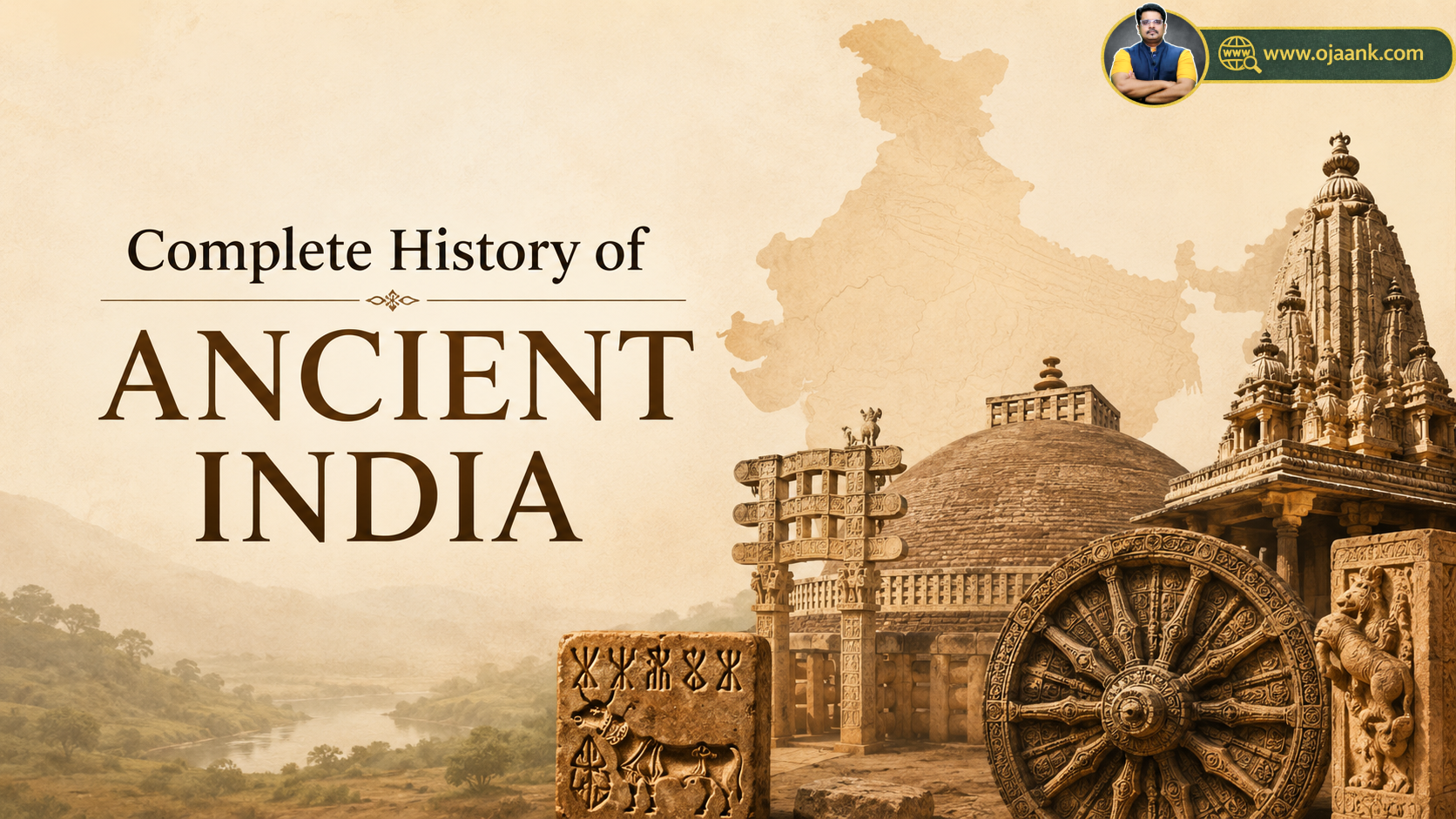
Complete History of Ancient India
Introduction
Ancient Indian history represents one of the world's oldest and most influential civilizations. It encompasses the development of early human societies, urban civilizations, religious movements, powerful empires, scientific advancements, and cultural achievements that shaped not only India but also the broader Asian world.
The period of Ancient India generally extends from prehistoric times to approximately the 8th century CE.
1. Prehistoric Period
The Prehistoric Period refers to the era before the invention of writing.
Paleolithic Age (Old Stone Age)
Key Features
- Humans lived as hunters and gatherers.
- Stone tools were widely used.
- People lived in caves and natural shelters.
- Discovery and use of fire marked a major advancement.
Important Sites
6
- Bhimbetka (Madhya Pradesh)
- Narmada Valley
- Belan Valley (Uttar Pradesh)
Mesolithic Age (Middle Stone Age)
Key Features
- Introduction of microliths (small stone tools).
- Beginning of animal domestication.
- Semi-settled lifestyle emerged.
Neolithic Age (New Stone Age)
Key Features
- Development of agriculture.
- Domestication of animals.
- Establishment of permanent settlements.
- Use of pottery.
Important Sites
- Mehrgarh
- Burzahom
- Koldihwa
- Chirand
2. Indus Valley Civilization (2500–1900 BCE)
The Indus Valley Civilization was one of the world's earliest urban civilizations.
4
Major Cities
- Harappa
- Mohenjo-daro
- Dholavira
- Lothal
- Kalibangan
- Rakhigarhi
Major Features
Urban Planning
- Grid-pattern streets
- Baked brick houses
- Advanced drainage system
Economy
- Agriculture
- Trade and commerce
- Craft production
Religion
- Mother Goddess worship
- Proto-Shiva (Pashupati) figure
- Tree and animal worship
Causes of Decline
- Climate change
- River course shifts
- Economic decline
3. Vedic Period (1500–600 BCE)
The Vedic Age marks the arrival and settlement of the Aryans in India.
Early Vedic Period (1500–1000 BCE)
Features
- Composition of the Rigveda
- Tribal political system
- Pastoral economy
- Simple social structure
Political Institutions
- Raja (King)
- Sabha
- Samiti
Later Vedic Period (1000–600 BCE)
Developments
- Expansion of agriculture
- Use of iron technology
- Emergence of kingdoms
Social Structure
- Consolidation of the Varna System
- Brahmins
- Kshatriyas
- Vaishyas
- Shudras
4. Age of Mahajanapadas (600–321 BCE)
Ancient India witnessed the rise of sixteen powerful states known as Mahajanapadas.
Important Mahajanapadas
- Magadha
- Kosala
- Vatsa
- Avanti
Rise of Magadha
Reasons for its success:
- Fertile Gangetic plains
- Rich iron resources
- Strategic location
Important Rulers
- Bimbisara
- Ajatashatru
- Mahapadma Nanda
5. Rise of Buddhism and Jainism
The 6th century BCE witnessed significant religious reforms.
Jainism
Founder
Mahavira
Core Principles
- Non-violence (Ahimsa)
- Truth (Satya)
- Non-stealing (Asteya)
- Non-possession (Aparigraha)
Buddhism
Founder
Gautama Buddha
Four Noble Truths
- Life is suffering.
- Suffering has a cause.
- Suffering can end.
- There is a path to end suffering.
Eightfold Path
- Right View
- Right Intention
- Right Speech
- Right Action
- Right Livelihood
- Right Effort
- Right Mindfulness
- Right Concentration
6. Mauryan Empire (321–185 BCE)
The Mauryan Empire was the first large-scale empire in Indian history.
4
Chandragupta Maurya
Chandragupta Maurya
Achievements
- Defeated the Nanda Dynasty
- Established a vast empire
Bindusara
- Expanded the empire further
Ashoka the Great
Ashoka
Kalinga War (261 BCE)
The devastation of the war led Ashoka to embrace Buddhism.
Contributions
- Spread Buddhism
- Issued Rock and Pillar Edicts
- Promoted Dhamma
7. Post-Mauryan Period
Several dynasties emerged after the fall of the Mauryas.
Major Dynasties
- Shunga Dynasty
- Kanva Dynasty
- Satavahana Dynasty
- Indo-Greeks
- Shakas
- Kushanas
Kushana Empire
Important Ruler
Kanishka
Contributions
- Patron of Buddhism
- Fourth Buddhist Council
- Growth of Gandhara Art
8. Gupta Empire (320–550 CE)
The Gupta Period is often called the "Golden Age of Ancient India."
7
Important Rulers
Chandragupta I
Founder of Gupta power.
Samudragupta
Samudragupta
- Military conquests
- Prayaga Prashasti
Chandragupta II (Vikramaditya)
- Expansion of empire
- Promotion of arts and culture
Achievements of the Gupta Age
Science and Mathematics
Aryabhata
- Contributions to astronomy
- Development of mathematical concepts
Literature
Kalidasa
Major Works:
- Abhijnanasakuntalam
- Meghadutam
Art and Architecture
- Ajanta Paintings
- Temple Architecture
- Sculptural Excellence
9. Harsha Empire (606–647 CE)
After the Guptas, Harsha emerged as a major ruler of North India.
Harshavardhana
Harshavardhana
Capital
- Kannauj
Contributions
- Religious tolerance
- Patronage of education
- Promotion of Buddhism
Foreign Visitor
Xuanzang
His writings provide valuable information about India during Harsha's reign.
Major Contributions of Ancient India
Education
- Takshashila
- Nalanda University
- Vikramashila University
Mathematics
- Decimal System
- Concept of Zero
- Algebra and Geometry
Medicine
- Ayurveda
- Surgery
- Contributions of Charaka and Sushruta
Philosophy
- Samkhya
- Yoga
- Nyaya
- Vedanta
Conclusion
Ancient India laid the foundation of Indian civilization through remarkable achievements in governance, philosophy, religion, science, mathematics, literature, and culture. From the Indus Valley Civilization to the reign of Harshavardhana, this period witnessed the emergence of powerful empires, influential religions, and enduring intellectual traditions that continue to shape modern India.