How to Read NCERT for UPSC Preparation in (2026)
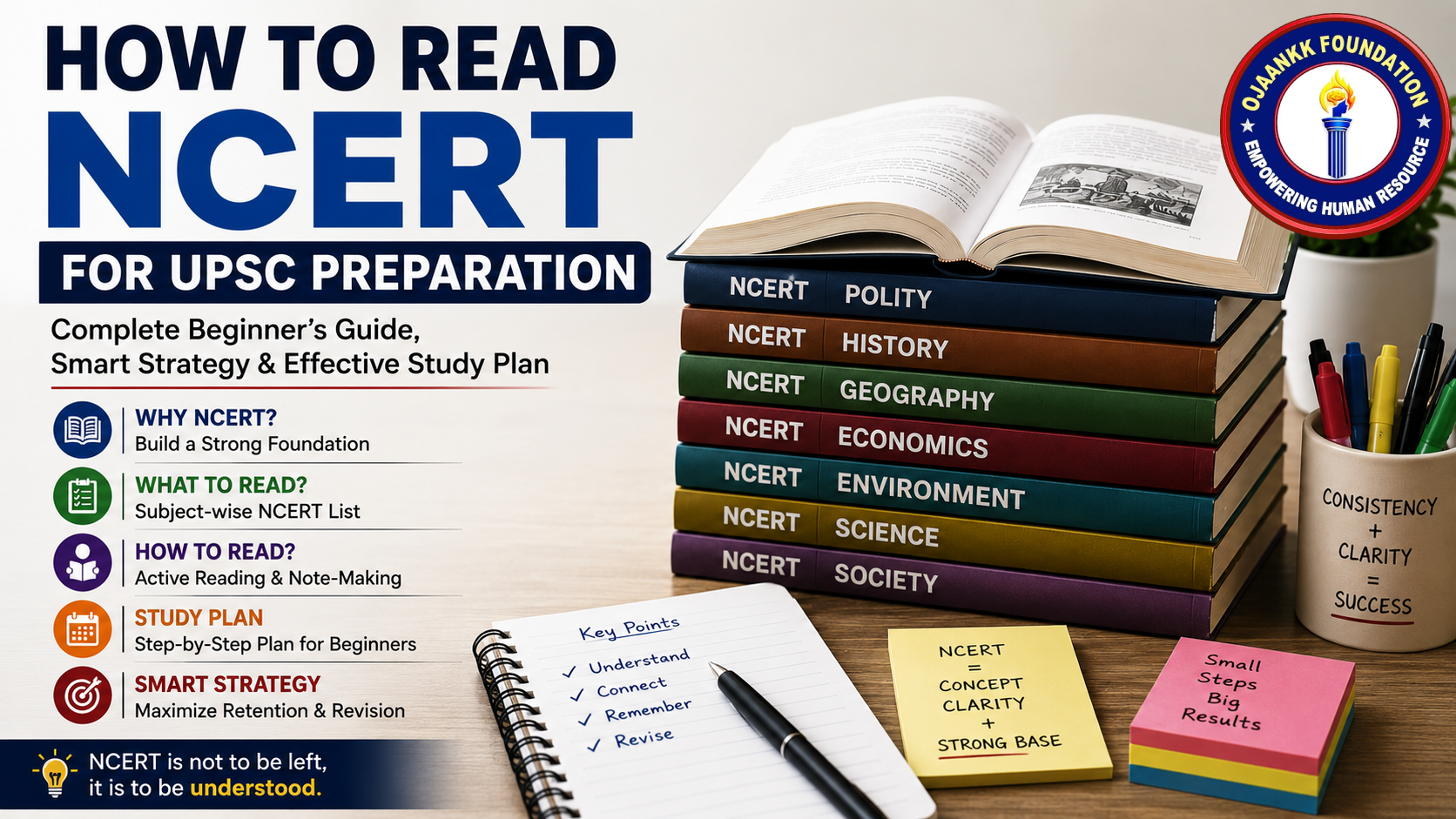
How to Read NCERT for UPSC Preparation
Complete Beginner’s Guide, Smart Strategy & Effective Study Plan
Introduction
Every serious UPSC aspirant begins their preparation journey with one common recommendation:
“Start with NCERT books.”
NCERT books are considered the foundation of UPSC Civil Services Examination preparation because they help students develop:
-
Conceptual clarity
-
Strong fundamentals
-
Analytical understanding
-
Subject interlinking ability
Whether you are preparing for:
-
UPSC Prelims
-
UPSC Mains
-
Essay Paper
-
Current Affairs Integration
NCERT books play an essential role at every stage of preparation.
However, many aspirants remain confused about the following:
-
Which NCERT books should be read?
-
How should NCERTs be studied effectively?
-
How many revisions are necessary?
-
Should notes be prepared from NCERTs?
-
Are old NCERTs better than new NCERTs?
This detailed guide explains the complete strategy to read NCERT books effectively for UPSC preparation.
Why are NCERT Books Important for the UPSC?
NCERT books are extremely important because they:
-
Build strong conceptual foundations
-
Explain topics in simple language
-
Improve analytical thinking
-
Help in answer writing
-
Provide authentic information
-
Prepare a base for advanced reference books
UPSC frequently asks:
-
Conceptual questions
-
Static GK questions
-
Analytical questions
directly or indirectly from NCERT-based concepts.
NCERTs are especially important for:
-
History
-
Geography
-
Environment
-
Science
-
Society
-
Economy
Subject-Wise Important NCERT Books for UPSC
1. History NCERTs
Important Books
-
Class 6 — Our Past I
-
Class 7 — Our Past II
-
Class 8 — Our Past III
-
Class 11 — Ancient India
-
Class 11 — Medieval India
-
Class 12 — Modern Indian History
Focus Areas
-
Historical chronology
-
Freedom struggle
-
Art & culture
-
Social reform movements
2. Geography NCERTs
Important Books
-
Class 6–10 Geography
-
Class 11 — Physical Geography
-
Class 12 — Human Geography
-
Class 12 — India: People and Economy
Focus Areas
-
Physical geography
-
Indian geography
-
Climate
-
Agriculture
-
Maps and mapping
3. Polity NCERTs
Important Books
-
Democratic Politics
-
Indian Constitution at Work
Focus Areas
-
Constitution
-
Fundamental Rights
-
Parliament
-
Judiciary
-
Federalism
4. Economy NCERTs
Important Books
-
Indian Economic Development
-
Macroeconomics
Focus Areas
-
GDP
-
Inflation
-
Banking
-
Budget
-
Economic growth
5. Environment & Ecology
Important Sources
-
Biology NCERTs
-
Geography NCERTs
-
Science NCERTs
Important Topics
-
Biodiversity
-
Ecosystem
-
Climate change
-
Conservation
6. Science NCERTs
Important Books
-
Class 6–10 Science
-
Selective Biology (Class 11–12)
Focus Areas
-
Biotechnology
-
Space technology
-
Health science
-
Basic scientific concepts
Step-by-Step NCERT Reading Strategy for UPSC
Step 1: Start with Class 6–10 NCERTs
Beginners should first focus on:
-
Understanding basics
-
Building subject familiarity
-
Learning core concepts
These books create the foundation for advanced preparation.
Avoid directly starting with:
-
Laxmikanth
-
Spectrum
-
Advanced Economy books
without completing NCERT basics.
Step 2: Move to Class 11–12 NCERTs
Once the fundamentals become strong:
-
Read advanced NCERTs
-
Focus on conceptual understanding
-
Connect topics with current affairs
Class 11–12 NCERTs are highly important for
-
Geography
-
Economy
-
Society
-
Environment
Step 3: Read for Understanding, Not Memorization
UPSC focuses on:
-
Analytical understanding
-
Conceptual clarity
-
Application-based learning
While reading:
-
Understand themes
-
Identify interlinkages
-
Focus on conceptual understanding
Do not rush to complete books quickly.
Step 4: Highlight Important Concepts
Mark:
-
Definitions
-
Keywords
-
Constitutional terms
-
Important examples
-
Government schemes
This makes revision easier later.
Step 5: Prepare Short Notes
Create concise notes for:
-
Revision
-
Prelims facts
-
Mains answer writing
Good notes help save valuable time before examinations.
Step 6: Revise Multiple Times
Revision is the most important part of UPSC preparation.
Most successful aspirants revise NCERT books:
-
3 to 5 times
instead of reading too many sources.
Step 7: Solve Previous Year Questions (PYQs)
PYQs help aspirants understand:
-
UPSC trends
-
Frequently asked concepts
-
Important topics
This improves preparation efficiency.
Step 8: Link Current Affairs with NCERT
Examples:
-
Climate Change → Geography & Environment
-
Parliament News → Polity
-
Inflation → Economy
This improves analytical understanding for UPSC Mains.
Common Mistakes Students Make While Reading NCERTs
1. Ignoring NCERT Basics
Many students directly jump to advanced books.
Result:
-
Weak fundamentals
-
Poor conceptual clarity
2. Reading Without Revision
Without revision:
-
Retention becomes weak
-
Concepts fade quickly
3. Following Too Many Sources
Collecting excessive books creates confusion.
UPSC rewards:
-
Revision
-
Concept clarity
-
Consistency
not book collection.
4. Not Making Notes
Without notes:
-
Revision becomes difficult
-
Time management suffers
5. Memorizing Without Understanding
UPSC focuses more on:
-
Understanding
-
Analysis
-
Application
than rote learning.
Old NCERT vs New NCERT: Which is Better?
Old NCERTs
Useful for:
-
Ancient History
-
Medieval History
-
Geography
New NCERTs
Useful for:
-
Easy language
-
Updated information
-
Better presentation
Best Strategy:
Use a combination of both whenever necessary.
How NCERT Helps in UPSC Prelims
NCERT books are extremely useful for:
-
Static GK
-
Conceptual MCQs
-
Geography mapping
-
Environment
-
Science & Technology
Many UPSC Prelims questions are directly inspired from NCERT concepts.
How NCERT Helps in UPSC Mains
NCERT improves:
-
Answer writing structure
-
Conceptual clarity
-
Analytical thinking
-
Interdisciplinary understanding
NCERTs are also useful for:
-
Essay
-
Ethics
-
Society
-
Governance
topics.
Suggested Timeline for NCERT Completion
| Stage | Recommended Duration |
|---|---|
| First Reading | 2–3 Months |
| Revision | Continuous |
| PYQs & Notes | Alongside Preparation |
Avoid spending excessive time only on NCERTs.
Are NCERT Books Enough for UPSC?
NCERTs alone are not sufficient to clear UPSC.
However, they are:
-
The foundation
-
The starting point
-
The most important beginner resource
After completing NCERTs, aspirants should move on to:
-
Standard reference books
-
Current affairs
-
Answer writing practice
-
Mock tests
Conclusion
NCERT books form the backbone of UPSC preparation. They help aspirants build:
-
Strong fundamentals
-
Concept clarity
-
Analytical understanding
required for both Prelims and Mains.
UPSC success does not come from reading too many books. It comes from:
-
Strong basics
-
Smart revision
-
Consistency
-
Conceptual understanding
And NCERT books remain the best starting point for achieving all of these goals.
Frequently Asked Questions (FAQs)
1. How should beginners read NCERT for UPSC?
Beginners should first complete Class 6–10 NCERTs and then move to Class 11–12 books gradually.
2. How many times should NCERTs be revised?
Most toppers recommend revising NCERT books at least 3–5 times.
3. Should I make notes from NCERT books?
Yes. Short notes improve retention and help in quick revision before exams.
4. Are old NCERTs important for UPSC?
Yes, especially for History and Geography.
5. Can UPSC be cleared only with NCERT books?
No. NCERTs provide the foundation, but advanced books, current affairs, answer writing, and mock tests are also necessary.
Click here for more blogs: