Lok Sabha Delimitation Debate: Will India’s Federal Politics Change After 2026?
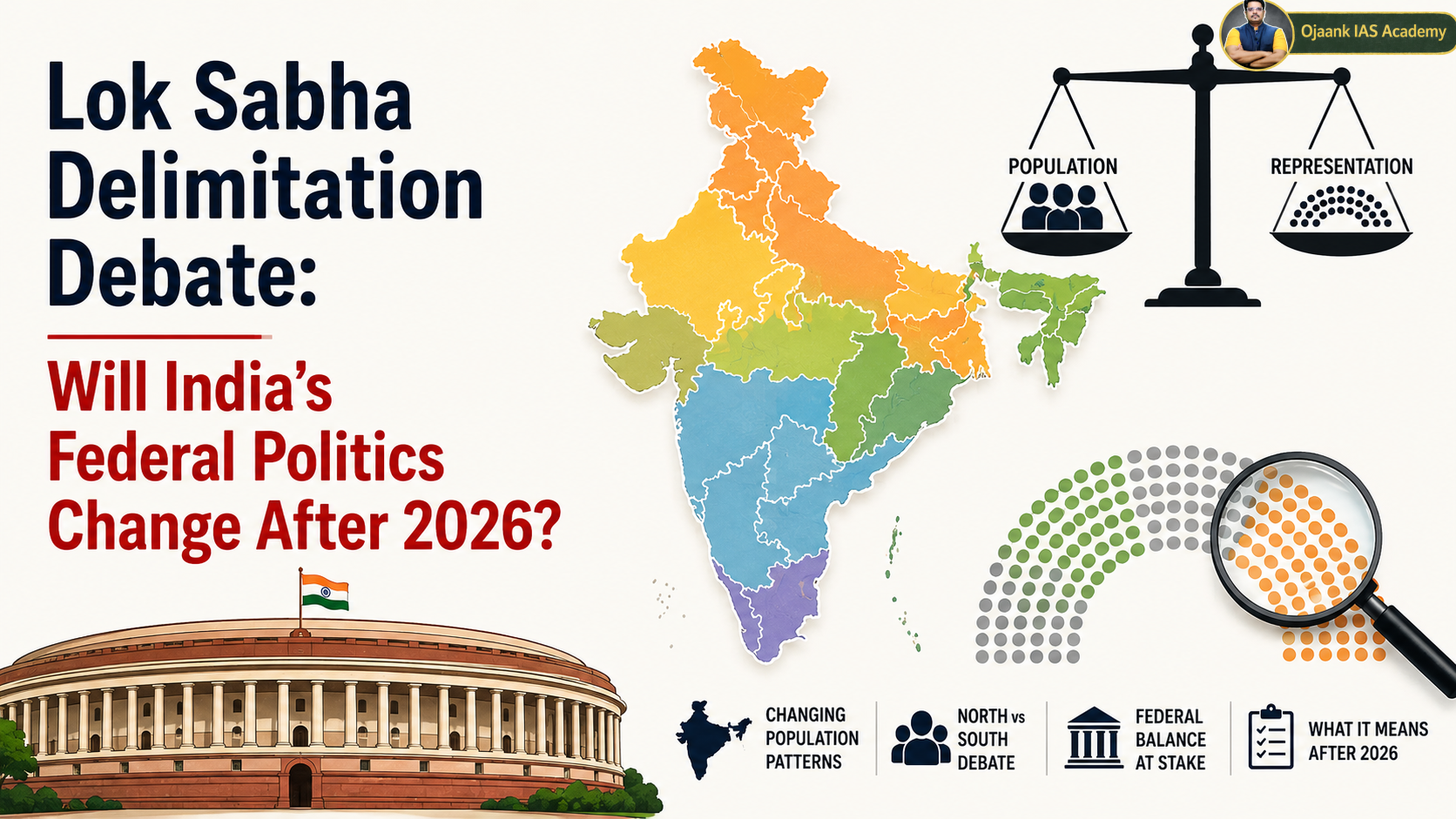
India’s upcoming delimitation exercise after 2026 is no longer just a technical electoral process. It has evolved into a major constitutional and political debate involving federalism, parliamentary power, democratic representation, and regional balance. The proposed 131st Constitutional Amendment Bill, which suggested increasing Lok Sabha seats from 550 to nearly 850, triggered strong political opposition before being withdrawn. (https://www.ojaank.com/)
At the center of the debate lies a fundamental democratic principle: “One Person, One Vote.” However, in a federal country like India, applying this principle purely on the basis of population creates complex political consequences. If seats are redistributed strictly according to population growth, northern states with higher population increases may gain significantly greater representation, while southern states could experience a relative decline in political influence. This has transformed delimitation into a wider debate about democracy versus federal balance.
Why This Debate Matters Right Now
- The constitutional freeze on delimitation is expected to end after 2026.
- Women’s reservation in Parliament has been linked to delimitation.
- Southern states fear political disadvantage despite successful population control policies.
What Is Delimitation?
Delimitation refers to the redrawing of parliamentary and assembly constituency boundaries based on population changes to ensure relatively equal representation.
The constitutional framework includes:
- Article 81(2): Seeks uniformity in the ratio between population and seats across states, as far as practicable.
- Articles 82 and 170: Provide for readjustment of Lok Sabha and Assembly seats after every Census.
The process is carried out by the Delimitation Commission, whose decisions carry the force of law and are generally beyond judicial review.
Why Could 2026 Become a Turning Point?
India froze delimitation through the 42nd Constitutional Amendment (1976) to ensure that states implementing family planning policies were not politically penalized. The freeze was later extended till 2026 through the 84th Constitutional Amendment (2001).
However, demographic changes over the last five decades have been uneven.
For example:
- States like Uttar Pradesh, Bihar, and Rajasthan experienced relatively high population growth.
- States such as Tamil Nadu, Kerala, and Andhra Pradesh successfully controlled population growth.
If seat allocation becomes fully population-based after 2026, northern states could gain substantially more parliamentary representation.
“One Person, One Vote” vs Federal Balance
This is the most sensitive dimension of the debate.
The democratic argument says:
Higher population → greater representation
The federal argument says:
Political voice in a union of states cannot depend solely on population size.
This is where southern states express concern. Their argument is that states that invested heavily in education, healthcare, and population stabilization should not be politically disadvantaged for their success.
The debate is therefore not merely about parliamentary seats. It is about the future structure of Indian federalism and the meaning of “unity in diversity.”
How Could Lok Sabha Expansion Reshape Political Power?
If Lok Sabha seats increase from around 550 to 850, India’s parliamentary power structure could change dramatically.
The political mechanism may work like this:
Larger population states → more seats → more MPs → greater influence in national politics
This could affect:
- National party strategies
- Coalition politics
- Allocation of central resources
- Centre-state relations
Southern states fear that despite contributing strongly to India’s economy and governance indicators, their bargaining power within Parliament could decline.
Could Delimitation Also Affect Economic Federalism?
Parliamentary representation often influences resource allocation and political bargaining.
If populous states gain greater representation:
- Distribution of central schemes may shift.
- Finance Commission debates could become more contentious.
- Fiscal federalism tensions may increase.
Another concern is that if higher population growth results in greater political power, states may have weaker incentives to pursue population stabilization policies in the future.
Why Is Women’s Reservation Linked to Delimitation?
The 106th Constitutional Amendment Act, 2023 introduced 33% reservation for women in Lok Sabha and State Assemblies. However, its implementation has been linked to the next delimitation exercise.
This creates a new political complication:
Delay in delimitation → delay in women’s reservation implementation
As a result, delimitation is now linked not only to representation and federalism, but also to gender equity in politics.
Is the 2011 Census Data Still Adequate?
This is another major source of controversy.
India’s latest published Census data is from 2011, while the 2021 Census has been delayed.
Critics argue:
Using outdated population data → inaccurate representation of current demographic realities
Major changes since 2011 include:
- Large-scale urban migration
- Expansion of metropolitan populations
- Informal settlements
- Climate-induced migration
These demographic shifts may not be properly reflected in older Census figures.
How Can Technology Improve Delimitation?
Technology can make the delimitation process more transparent, scientific, and data-driven.
Potential tools include:
- GIS (Geographic Information Systems) mapping
- AI-based demographic analysis
- Digital Census systems
- Migration trend analytics
These technologies can help create more balanced and representative constituencies. However, data quality and administrative capacity remain major challenges.
What Can India Learn from Other Countries?
The United States redraws districts after every decennial Census, while the United Kingdom uses independent boundary commissions to ensure fairness.
Key lessons for India include:
- Transparent and independent processes
- Avoiding political manipulation and gerrymandering
- Combining population with geographical and cultural considerations
- Conducting timely and reliable Census updates
India’s challenge is uniquely complex because of its scale, diversity, and federal structure.
What Does This Mean for India?
The delimitation exercise could reshape Indian politics for decades.
It may affect:
- Parliamentary power balance
- North-South political relations
- Distribution of resources
- Regional party influence
- Nature of Indian federalism
Without broad political consensus, delimitation could deepen regional tensions and weaken trust in federal institutions.
What If the Freeze Had Never Happened?
If India had not frozen delimitation in 1976, the country’s parliamentary structure today would likely look very different. At the same time, without political protection for states implementing population control policies, family planning efforts may have weakened.
The current controversy is therefore not simply about present-day politics but also about decades-old constitutional compromises.
What Could Happen Next?
- Best Case: India develops a consensus-based delimitation model balancing democracy and federalism.
- Most Likely: Long political negotiations continue over population-based seat allocation.
- Worst Case: Delimitation intensifies North-South polarization and federal tensions.
Conclusion
The Lok Sabha delimitation debate is emerging as one of the most significant constitutional challenges facing Indian democracy. It is not merely about increasing parliamentary seats but about deciding how India balances equal representation with federal stability.
The choices made after 2026 could redefine the future of Indian federalism, democratic legitimacy, and national political cohesion.
FAQs
Q1. What is delimitation?
Delimitation is the process of redrawing electoral constituency boundaries based on population changes.
Q2. Why is delimitation after 2026 important?
Because the constitutional freeze on seat readjustment, extended through the 84th Constitutional Amendment, is expected to end after 2026.
Q3. Why are southern states concerned?
They fear losing relative political influence if parliamentary seats are redistributed strictly according to population growth.
Q4. How is women’s reservation connected to delimitation?
The 106th Constitutional Amendment links implementation of 33% reservation for women to the next delimitation exercise.
Q5. Should delimitation depend only on population?
This remains the core debate. Many experts argue that federal balance, geography, and regional diversity should also be considered alongside population.
Click here for more blogs: