Sam Altman's AI Singularity Prediction Explained: What It Means for India & UPSC
Sam Altman's AI Singularity Prediction Explained: What It Means for India & UPSC

Introduction
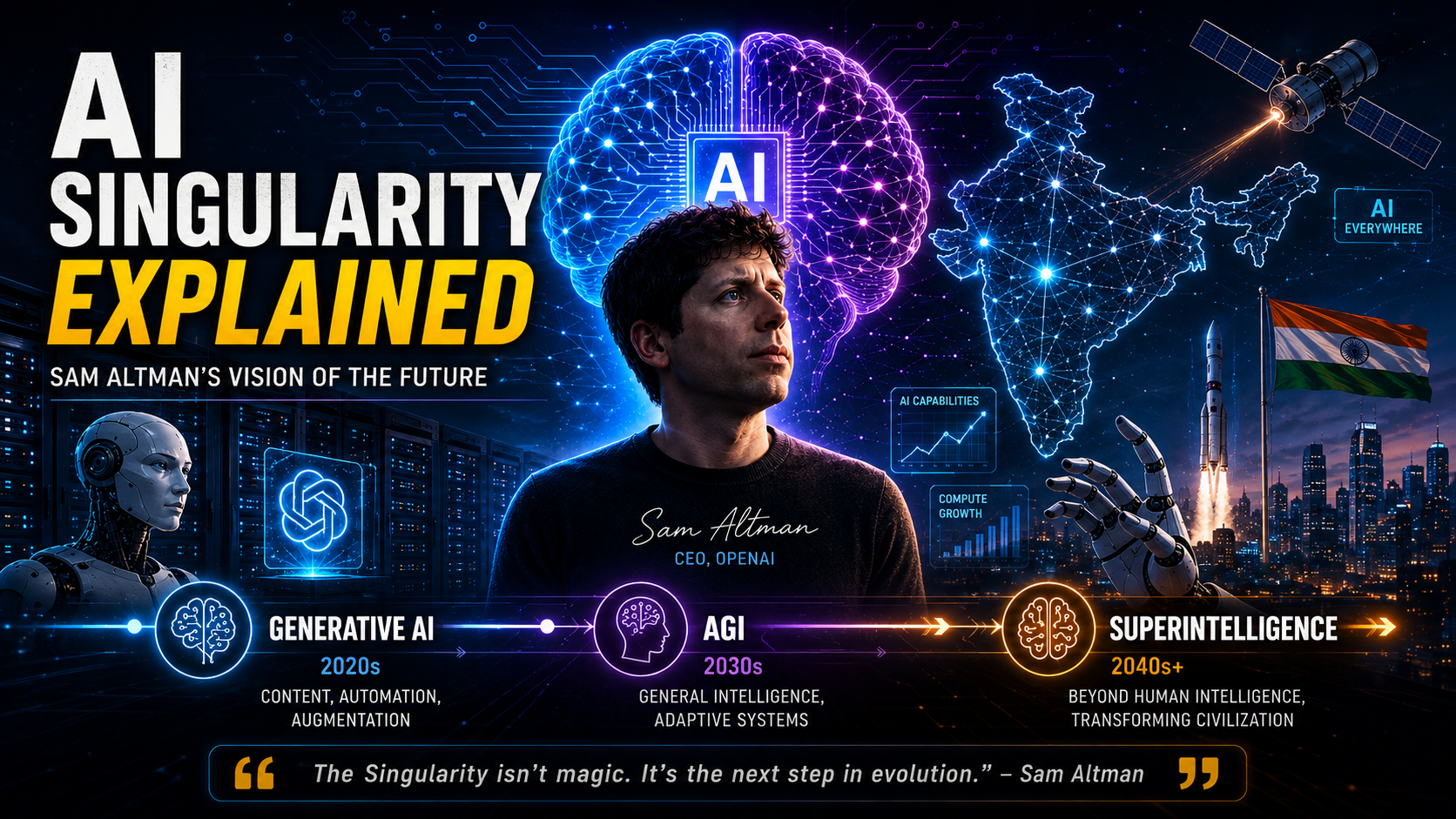
OpenAI CEO Sam Altman recently stated that humanity has already entered the AI singularity, arguing that artificial intelligence is advancing along an exponential path rather than through one dramatic breakthrough. His comments have reignited global debate about whether AI has crossed a historic technological threshold or whether the term is being used too broadly.
The statement has implications far beyond technology. It raises questions about jobs, governance, economic growth, cybersecurity, ethics, education, and national competitiveness. For India, which is rapidly expanding its AI ecosystem, the debate is especially significant.
Why This Matters Now
- AI capabilities are improving rapidly across coding, research, healthcare, and automation.
- Experts remain divided on whether the world has truly entered the "singularity."
- India is investing heavily in AI infrastructure, regulation, and digital innovation through initiatives such as the IndiaAI Mission.
Background
The concept of the technological singularity refers to a hypothetical stage where artificial intelligence becomes capable of improving itself faster than humans can improve it, leading to extremely rapid technological progress.
Sam Altman argues that AI is already following this trajectory and that society is gradually adapting to accelerating technological change rather than experiencing a sudden disruption. However, several AI researchers disagree, noting that current systems still depend heavily on human oversight and have not achieved autonomous recursive self-improvement.
Main Analysis
What Is AI Singularity?
AI singularity is the theoretical point at which artificial intelligence surpasses human intelligence across most domains and begins improving itself with minimal human intervention.
Although widely discussed in AI research and science fiction, there is no universally accepted definition or timeline for when—or whether—it will occur.
Why Did Sam Altman Make This Claim?
According to Altman, AI development has reached a stage where exponential progress is becoming the new normal. He believes the transition feels gradual because people quickly adapt to each technological breakthrough rather than recognizing a single historic moment.
His broader argument is that AI will increasingly contribute to scientific discovery, software development, robotics, and economic productivity.
Why Many Experts Disagree
Several prominent AI researchers argue that today's AI models remain powerful tools rather than autonomous superintelligence.
Critics point out that current systems:
- Still require extensive human supervision.
- Cannot independently pursue long-term goals.
- Lack true self-awareness.
- Do not continuously redesign themselves without human involvement.
For these experts, today's AI represents remarkable progress—but not the singularity itself.
Opportunities for India
Rapid AI advancement could create major opportunities in:
- Healthcare diagnostics
- Precision agriculture
- Smart manufacturing
- Education technology
- Public service delivery
- Scientific research
- Language technologies for Indian languages
India's growing digital infrastructure, startup ecosystem, and skilled workforce position it to benefit significantly from responsible AI adoption.
Challenges India Must Prepare For
Accelerating AI also brings significant policy challenges:
- Job displacement in routine occupations
- Cybersecurity risks
- Algorithmic bias
- Data privacy concerns
- Misinformation and deepfakes
- High computing infrastructure costs
- Need for AI regulation and ethical governance
Balancing innovation with safety will be essential for sustainable AI development.
What This Means for India
India is emerging as one of the world's fastest-growing AI markets. Whether or not the singularity has truly arrived, rapid AI progress makes investment in digital infrastructure, semiconductor capabilities, AI research, talent development, and regulatory capacity increasingly important.
Government initiatives such as the IndiaAI Mission, along with responsible AI frameworks and public-private collaboration, will play a crucial role in ensuring that AI contributes to inclusive economic growth while minimizing risks.
What Happens Next
Best Case
AI accelerates scientific breakthroughs, economic productivity, healthcare, and education while governments successfully establish effective safety and governance frameworks.
Most Likely Case
AI capabilities continue improving rapidly, with policymakers adapting regulations and industries gradually integrating increasingly capable AI systems.
Worst Case
Uncontrolled AI deployment leads to widespread misinformation, cyber threats, economic disruption, and regulatory challenges that outpace governance mechanisms.
Conclusion
Sam Altman's claim that humanity has entered the AI singularity represents one of the boldest statements in the ongoing AI debate. While many researchers agree that AI is advancing at an extraordinary pace, there is no consensus that the technological singularity has already arrived.
For India, the more important question is not whether the singularity has begun, but whether the country is prepared to harness AI responsibly. Investments in innovation, digital infrastructure, ethical governance, and human capital will determine how successfully India navigates the AI era.
UPSC Prelims Facts
- AI Singularity refers to the hypothetical point where AI surpasses human intelligence and rapidly improves itself.
- Sam Altman recently stated that humanity is already in the AI singularity, though this view remains contested.
- AI governance focuses on transparency, accountability, fairness, privacy, and safety.
- India is implementing the IndiaAI Mission to strengthen AI infrastructure and innovation.
- AI is increasingly applied in healthcare, agriculture, education, manufacturing, and governance.
Mains Value Addition
GS Paper II: Emerging Technologies, Digital Governance
GS Paper III: Artificial Intelligence, Science & Technology, Cyber Security
Essay Themes:
- Artificial Intelligence and Human Development
- Ethics of Emerging Technologies
- AI and Future of Employment
- India's Roadmap for Responsible AI
FAQs
1. What is AI singularity?
It is the theoretical stage where AI becomes capable of outperforming humans across most tasks and improving itself autonomously.
2. What did Sam Altman say?
Sam Altman stated that humanity has already entered the AI singularity, arguing that AI is advancing along a continuous exponential curve.
3. Do all experts agree?
No. Many AI researchers argue that current AI systems remain dependent on human oversight and do not yet meet the classic definition of technological singularity.
4. Why is this important for India?
AI will influence economic growth, employment, education, governance, national security, and digital competitiveness.
5. Why is this topic important for UPSC?
It connects Science & Technology, Ethics, Governance, Economy, Cyber Security, and International Technology Policy, making it relevant across multiple GS papers.