US–Saudi Nuclear Deal Explained: Impact on West Asia, Iran & India
US–Saudi Nuclear Deal Explained: Impact on West Asia, Iran & India

Introduction
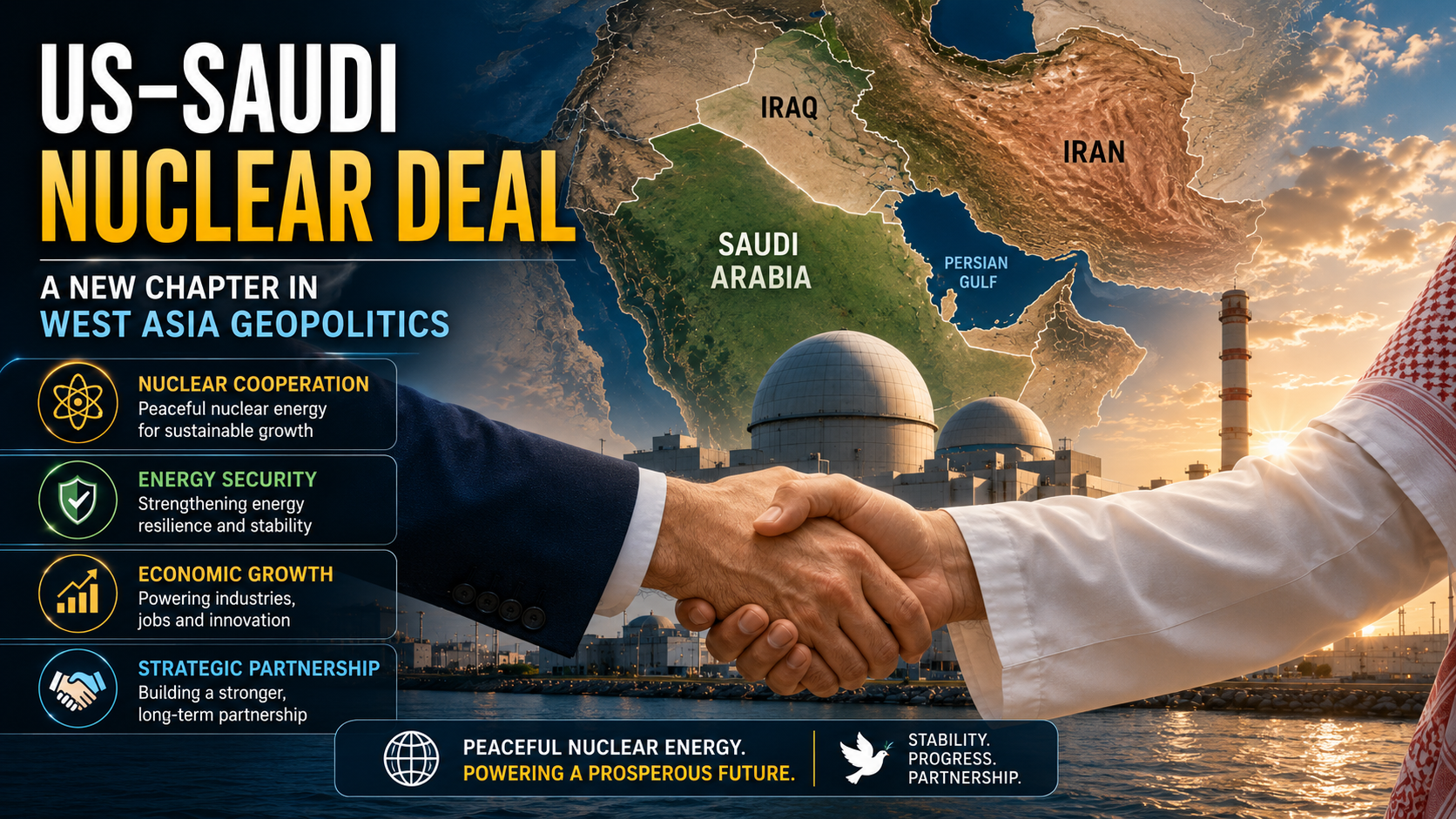
The proposed US–Saudi Nuclear Deal has emerged as one of the most significant strategic developments in West Asia. It seeks to expand cooperation on Saudi Arabia's civilian nuclear energy ambitions while strengthening the long-standing partnership between Washington and Riyadh.
Beyond energy, the proposed arrangement has broader geopolitical implications. It could influence regional power dynamics, affect relations with Iran, reshape security calculations in West Asia, and carry important consequences for India's energy security and foreign policy.
Why This Matters Now
- Civil nuclear cooperation could redefine strategic partnerships in West Asia.
- The proposal has implications for regional security, nuclear non-proliferation, and geopolitical competition.
- India has significant strategic and energy interests linked to stability in the Gulf region.
Background
Saudi Arabia has announced plans to diversify its energy mix and develop a civilian nuclear power programme as part of its long-term economic transformation strategy. The United States has been engaged in discussions on possible civil nuclear cooperation, subject to legal, technical, and non-proliferation requirements.
Such agreements generally involve cooperation on nuclear technology, reactor development, safety standards, and fuel-cycle management. Any final arrangement depends on negotiations and domestic legal approvals.
Main Analysis
Why Saudi Arabia Wants Civil Nuclear Energy
Saudi Arabia aims to reduce dependence on hydrocarbons for domestic electricity generation while meeting rising energy demand. Civilian nuclear power can help diversify the country's energy sources, support industrial growth, and free more oil for export.
The programme is also linked to the country's long-term economic diversification agenda.
Strategic Interests of the United States
For the United States, nuclear cooperation strengthens strategic ties with an important regional partner while providing an opportunity to shape nuclear governance through safeguards and international standards.
The partnership also supports broader American interests in maintaining stability and influence in West Asia amid increasing geopolitical competition.
Regional Implications for Iran and West Asia
The proposal is closely watched by regional actors because shifts in Saudi Arabia's technological capabilities could influence the strategic balance in West Asia.
Iran may view expanded US–Saudi cooperation through the lens of regional security and existing geopolitical rivalries. At the same time, supporters argue that internationally supervised civilian nuclear cooperation can promote transparency and adherence to non-proliferation norms.
Nuclear Non-Proliferation and International Safeguards
Civil nuclear cooperation is generally expected to operate within the framework of the Treaty on the Non-Proliferation of Nuclear Weapons (NPT) and the safeguards system of the International Atomic Energy Agency (IAEA).
These mechanisms are designed to ensure that civilian nuclear technology remains dedicated to peaceful purposes while maintaining international oversight.
Implications for Global Energy Markets
Saudi Arabia remains one of the world's leading energy exporters. A diversified domestic energy mix could allow more hydrocarbons to be directed toward international markets over the long term, although any impact would depend on future implementation.
More broadly, stable strategic relations in the Gulf contribute to confidence in global energy supply chains.
What This Means for India
India maintains strong strategic partnerships with both the United States and Saudi Arabia while also having important interests in regional stability. A secure and stable Gulf region is critical for India's energy imports, trade routes, and the welfare of the Indian diaspora.
India is also an advocate of peaceful uses of nuclear energy under international safeguards. Developments in regional nuclear cooperation may influence India's diplomatic engagement, energy security planning, and broader West Asia policy.
What Happens Next
Best Case
A civilian nuclear cooperation framework is concluded with robust international safeguards, contributing to regional energy diversification and strategic stability.
Most Likely Case
Negotiations continue as participating countries address technical, legal, security, and non-proliferation issues before reaching any final agreement.
Worst Case
If negotiations stall or regional tensions increase, strategic mistrust could deepen, complicating diplomatic engagement and affecting broader regional stability.
Conclusion
The proposed US–Saudi Nuclear Deal extends beyond energy cooperation. It sits at the intersection of geopolitics, nuclear governance, regional security, and international diplomacy. While the final shape of any agreement remains subject to negotiation, its potential impact on West Asia, Iran, and global energy security makes it an important development for policymakers and UPSC aspirants alike.
UPSC Prelims Facts
- Saudi Arabia is a major oil exporter and a key strategic partner of the United States.
- The IAEA monitors peaceful uses of nuclear energy through safeguards.
- The NPT seeks to prevent the spread of nuclear weapons while promoting peaceful nuclear cooperation.
- Civilian nuclear agreements typically involve technology transfer, safety cooperation, and regulatory oversight.
- West Asia remains central to global energy security and maritime trade.
Mains Value Addition
GS Paper II: International Relations, India–West Asia Relations
GS Paper III: Energy Security, Nuclear Technology, Strategic Affairs
Essay Themes:
- Nuclear Energy and Global Security
- India's West Asia Policy
- Energy Transition and Geopolitics
- Strategic Partnerships in a Multipolar World
FAQs
1. What is the proposed US–Saudi Nuclear Deal?
It refers to discussions on civilian nuclear cooperation between the United States and Saudi Arabia, subject to legal, technical, and international safeguards.
2. Why is it strategically important?
It has implications for energy diversification, regional security, geopolitical alignments, and nuclear non-proliferation.
3. How could Iran be affected?
The proposal may influence regional security perceptions and strategic calculations, though its precise impact depends on the final terms and broader geopolitical developments.
4. Why is the deal relevant for India?
India has major energy, trade, and strategic interests in West Asia, making regional stability an important foreign policy priority.
5. Which international institutions are relevant?
The International Atomic Energy Agency (IAEA) and the Treaty on the Non-Proliferation of Nuclear Weapons (NPT) are central to civilian nuclear cooperation and safeguards.